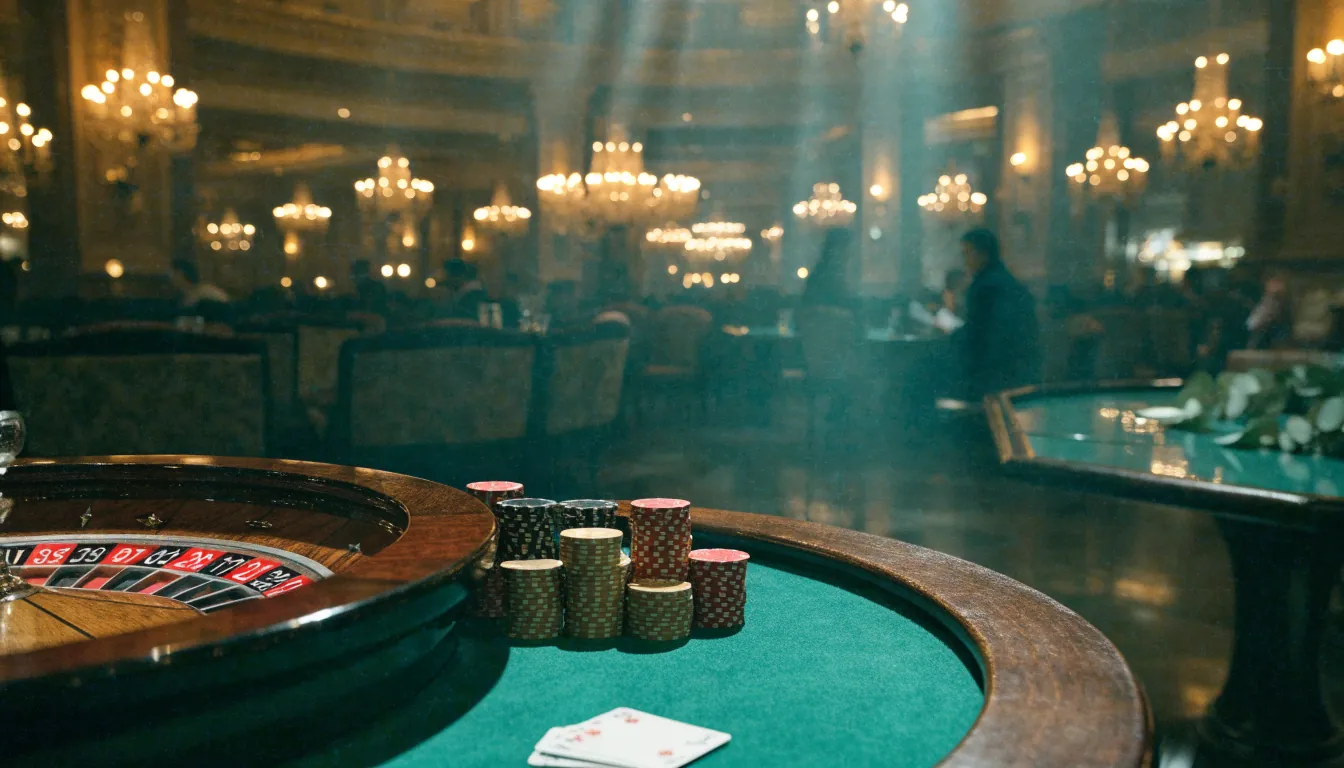
Software-based games use RNGs to determine outcomes, while live dealer games show a real dealer and physical casino equipment on video.

Online table games can be presented through software or through a live video stream. The distinction concerns how the game is conducted and how its outcome is produced; it does not change the legal status of real-money online casino services in Australia.
In a software-based version, a Random Number Generator (RNG) determines the relevant result. For a card game, it determines which cards are dealt; for roulette, it determines where the ball lands. The interface may represent a table, cards, a wheel or other casino equipment, but the outcome is generated by software rather than by a physical dealer conducting a streamed game. A digital table therefore should not be confused with a live table merely because both are displayed on a screen.
Live dealer games use a different presentation. A real dealer and real casino equipment are shown in video streamed to players. The stream places an actual person and physical equipment at the centre of the game, rather than relying solely on a software-rendered table. This describes the format, not a separate legal category or an assurance about any particular service. Both software-based and live dealer formats fall within the broad subject of online casino table games when offered as interactive casino gambling.
Choosing a real-money casino for table games in Australia involves weighing the details that are available about each operator. This list offers a concise reference to those details.
Kingmaker
Kingmaker lists a minimum deposit of A$30. Its stated payout times are around 90 minutes for crypto and 1–5 days for fiat.
LevelUp Casino
LevelUp Casino lists a minimum deposit of A$15 and a Curacao eGaming licence, OGL/2023/174/0082, held by Dama N.V.
SkyCrown
SkyCrown lists a Tobique Gaming Commission licence and a minimum deposit of A$30. Its stated payout times are around 10–15 minutes for crypto and 1–5 days for fiat.
Bizzo Casino
Bizzo Casino is listed with a Curacao Gaming Control Board licence held by TechSolutions Group N.V.
GoldenCrown
GoldenCrown is listed with a Curacao Gaming Control Board licence, OGL/2023/176/0095, held by Hollycorn N.V.
SpinsUp
SpinsUp is listed with a Curacao Gaming Control Board licence, OGL/2023/174/0082, held by Dama N.V.
Golden Pokies
Golden Pokies is listed as operating under a Curacao licence.
Uptown Pokies
Uptown Pokies is listed as operating under a Curacao licence and as having operated since 2017. Its minimum deposit is A$20.
Rollero Casino
Rollero Casino is listed with a Curacao Gaming Control Board licence, OGL/2023/176/0095, held by Hollycorn N.V.
MrPacho
MrPacho lists a minimum deposit of A$30. Its stated payout times are 30–120 minutes for crypto and 24–72 hours for fiat.
The contrast is useful because the word “online” can describe more than one production method. A game may be online because software determines the result, or because a live game is transmitted over video. A visual resemblance between formats does not establish that they operate in the same way: a simulated wheel and a streamed physical wheel have different stated mechanisms. Likewise, the presence of a dealer on camera distinguishes the live format, but does not by itself establish anything about the operator’s legal position, the game’s terms or the availability of a service in Australia.
“Real money” also needs to be separated from the format question. It refers to gambling with money rather than merely viewing a game or interacting with a non-monetary demonstration. The existence of a software version or a live stream does not establish that real-money use is lawful. Nor does a description of a game as free establish that it is equivalent to real-money gambling: the distinction rests on whether money is wagered, while the format rests on how the game is presented and how its outcome is determined. These are separate dimensions, not interchangeable labels.
In Australia, the legal context is decisive. The Interactive Gambling Act 2001 (IGA) prohibits operators from providing real-money online casino games to people physically located in Australia. The prohibition covers casino-style interactive services, rather than turning on whether a table is software-based or shown through a live stream. Section 5 also prohibits operators based in Australia from offering real-money interactive casino games to residents. Accordingly, the description of a format should not be read as an invitation or as confirmation that real-money online casino play is a lawful service for Australian residents.
The Australian Communications and Media Authority (ACMA) is responsible for enforcing compliance and blocks unlicensed platforms. This enforcement context matters when interpreting descriptions of online tables, live dealers or international services. A site’s claim that it offers a particular format does not establish that the service is permitted for people in Australia, and the technical ability to display a game does not remove the statutory restriction. The existence of online material about casino games is not evidence that the underlying real-money service is lawful or accessible.
This distinction also limits what can be inferred from general descriptions of online play. A software-generated result identifies the stated role of an RNG; it does not, on its own, describe every feature of a game. A live stream identifies a real dealer and physical equipment; it does not establish the terms or regulatory status of the service. Details such as particular tables, operating conditions, payment arrangements or promotional offers cannot be derived simply from knowing which format is used.
Thus, online table games and live dealer play are best understood as two presentation and outcome-production models within a broader category. Software-based games use an RNG to determine results, while live dealer games show a real dealer and casino equipment through a video stream. In Australia, that technical distinction does not override the IGA’s prohibition on providing real-money online casino games to people in the country.
A reference to Bitcoin alongside casino table games does not, by itself, establish that a particular service accepts Bitcoin, that its table games can be accessed using it, or that the payment arrangement differs favourably from another method. Those are separate claims. Establishing them would require information about the payment process and the games offered, tied to the same service and applicable at the same time.
The phrase “Bitcoin table games” can describe several different things: a game catalogue associated with a Bitcoin payment option, a balance denominated in Bitcoin, or simply a page that mentions both topics. These descriptions are not interchangeable. A payment method may be listed without being available for every transaction, while a game may appear in a catalogue without evidence that it can be played using that method. Neither wording alone confirms the relationship between payment and play.
A comparison with conventional payment arrangements would therefore need specific, comparable details. Relevant evidence would identify whether Bitcoin is accepted for deposits, withdrawals, or both; how the account balance is represented; and whether any exchange between Bitcoin and another currency occurs. The terms would also need to explain applicable charges, processing stages, and the handling of a transaction if it is delayed or rejected. Without those details, claims that Bitcoin is cheaper, faster, or more flexible than another method cannot be established.
Security is another distinct question. The presence of Bitcoin does not, on its own, demonstrate how funds are stored, who controls access to them, or what protections apply to an account or transaction. Those points depend on documented procedures and the responsibilities assigned to the parties involved. A general description of cryptocurrency is not evidence of the safeguards used by a particular service.
The game side requires equally specific documentation. A page describing table games does not prove that every listed game is available to accounts using Bitcoin, or that availability is consistent across locations and times. Evidence would need to connect the payment arrangement to the relevant game access and set out any conditions that affect it. A general label such as “Bitcoin casino table games” cannot establish the size or composition of a catalogue.
The same limits apply to requests for the best Bitcoin table games or a top selection. “Best” could refer to different criteria, including game rules, payment compatibility, access conditions, or other characteristics. A defensible comparison would first define the criterion, then use consistent and verifiable information for each option. Without that basis, ranking games or services would imply a level of comparison the available descriptions do not support.
Bitcoin is thus not a game format. It is a payment-related term, and its appearance beside blackjack, roulette, poker, or another table-game label does not alter how the game itself is described. Nor does it establish that a payment method changes a game’s rules or outcomes. Those questions concern different evidence and should not be collapsed into a single claim.
For Australian readers, payment terminology also cannot establish that a real-money online casino service is lawful or available. A Bitcoin label is not a licence, a regulatory status, or proof of access. Payment claims and legal status are separate matters; one cannot be inferred from the other.
Accordingly, evidence about Bitcoin and table games can support a comparison only when it identifies the actual payment terms, the games linked to them, and the conditions under which both apply. In the absence of those specifics, neither a preferred Bitcoin arrangement nor a “best” table-game choice can be substantiated.
A ranking of casino table games by odds requires more than the name of each game. “Best odds” can refer to different things: the chance of a particular outcome, the expected return under specified rules, or the house edge. These measures are related but not interchangeable. A game may offer frequent small wins while still having an unfavourable expected return, for instance; the frequency of winning alone does not establish which game has the better odds.
Randomness also does not provide a ranking. Online table games use a random number generator to determine outcomes, such as the cards dealt or where a roulette ball lands. That describes how an outcome is selected, not how likely each outcome is or how winnings are paid. A random process can produce different probability structures depending on the game’s rules and available bets.
A house-edge chart would therefore need to identify the particular rules and payouts being compared. A game label by itself does not establish those conditions. Even within a named format, changes to rules or betting options can affect the calculation. Without a defined basis for comparison, a chart that orders games from “best” to “worst” would present a precision that the labels alone cannot support.
The same caution applies to claims about the best odds at casino table games generally. A comparison needs a clearly stated measure and consistent assumptions across the games. If one figure represents the chance of winning a hand while another represents expected return over repeated play, placing them in a single ranking would be misleading. Nor does a game’s popularity establish its mathematical advantage.
Blackjack involves competing with the dealer to approach a hand value of 21, but that basic description does not specify every rule needed to calculate a house edge. Roulette formats differ in their numbered wheels: European and French versions have 36 numbered spaces and a green zero, while American Roulette has a green zero and a double-zero. Those details distinguish formats, but they do not, on their own, provide a complete comparison of payouts or establish a universal ranking.
Poker presents a different complication. Its stated aim is to build the strongest possible hand, but that description does not specify a particular variant, its rules, or the basis on which an odds figure should be calculated. A general label cannot serve as a substitute for a defined game and a defined measure.
It is therefore not sound to identify either the best or worst odds across casino table games from broad descriptions alone. That does not mean every game has identical odds; it means a ranking requires comparable, explicitly specified conditions. In Australia, this mathematical discussion should also be kept separate from legal availability: the Interactive Gambling Act 2001 prohibits operators from providing real-money online casino games, including table games, to people in Australia. A hypothetical odds comparison is not evidence that such play is legally offered.
Table-game outcomes depend on the event a wager is tied to. In blackjack, the relevant comparison is between a player’s hand and the dealer’s: the aim is for the player’s hand value to be closer to 21. In other formats, a bet may concern which hand prevails or whether the result is a tie. A dice game instead links the wager to the outcome of rolling a pair of dice. These are different ways of defining what a bet is settled against; they should not be treated as interchangeable rules.
Blackjack centres on a comparison of hand values. The player competes with the dealer, and the stated objective is to finish with a value closer to 21. The result therefore depends on the relationship between the two hands, rather than on a player’s hand being judged in isolation.
That distinction matters when describing how the game works. “Closer to 21” identifies the aim, but it does not by itself explain every possible result or every action that may affect a hand. The comparison is the central mechanic: the player’s outcome is considered against the dealer’s hand. A general explanation should not be mistaken for a complete account of the rules of a particular table.
The same principle helps separate a game’s objective from a bet’s settlement condition. A player may be trying to achieve a hand value near the target, while the eventual result depends on how that hand compares with the dealer’s. Simply naming the target does not specify all the circumstances in which a wager is resolved.
Some table-game wagers are framed around the outcome of a comparison between hands. A bet can be placed on the player’s hand, the Banker’s hand, or a tie. The possible selection is therefore not limited to backing one side: the tie is also an explicit outcome on which a wager may be placed.
This structure defines the subject of the bet, not the detailed rules used to produce the result. It indicates which hand or outcome a wager concerns, but does not establish how cards are dealt, how a hand is valued, or what procedure applies if the result is tied.
For someone learning how to play casino table games, this distinction is useful: first identify what the wager refers to, then distinguish that choice from the rules that determine the final result. A bet on a hand and a bet on a tie are different selections, even though both depend on the outcome of hands. The labels alone do not make the underlying procedure clear.
Comparison between the player's hand value and the dealer's hand, aiming to be closer to 21.
Wagers placed on the player's hand, the Banker's hand, or the possibility of a tie.
Wagers tied to the specific outcome of rolling a pair of dice.
A dice-based table game has a different basic action: players roll a pair of dice and bet on the outcome. Here, the wager is associated with what the roll produces, rather than with a player’s hand being compared against a dealer’s hand.
Those details should not be assumed from the fact that a pair of dice is involved.
Across these examples, the key question is what event determines the wager’s result: a hand compared with a dealer’s, a selection among hands or a tie, or the outcome of a dice roll.
A request for a casino close by is fundamentally about physical location: the relevant distance depends on where someone is and which venues are within reach. A phrase such as “nearest casino with table games” cannot identify a particular place without both a location and reliable information about venue locations and offerings. The same wording can therefore refer to different places for people in different parts of Australia.
Searches that name Miami or Ohio point to places in the United States, not Australian locations. They do not establish which venues, if any, are close to an Australian town or city. Nor does the phrase “new casino” by itself identify a venue or confirm when one opened. These distinctions matter because broad wording can suggest a local answer when it does not specify a usable Australian location.
The word “casino” also needs context. A request for a nearby physical venue is different from a request for online casino games. In Australia, the Interactive Gambling Act 2001 makes it illegal for operators to provide real-money online casino games to people physically in the country. The prohibition covers table games as well as other casino-style games. The Australian Communications and Media Authority enforces the rules and blocks unlicensed domestic platforms. A location-based search should not be treated as evidence that an online service is lawful or locally available.
Physical proximity and online availability are separate questions. A venue’s location, if established, would not demonstrate that it offers a particular table game; a description of a game would not show that a venue offering it is nearby. Likewise, wording about “table games near me” does not distinguish between a physical gaming floor and an online game. That distinction is especially important in Australia, where real-money online casino services are prohibited for operators providing them to people in the country.
A reliable local description would need to tie a named venue to an Australian place and state what its table-game offering is. Without that connection, claims about the closest casino, a local venue’s games, or a newly opened casino would be uncertain. Location terms such as suburb, city, or region can narrow the intended area, but they do not independently verify a venue or its facilities.
While a search for a "nearby" casino refers to physical geography, it is important to distinguish this from online services. In Australia, providing real-money online casino games is prohibited under the Interactive Gambling Act 2001, regardless of the user's perceived proximity to a service.
The practical meaning of “nearby” is therefore geographic, not a property of a game. It varies with the starting point and the destination, while the type of destination must also be clear. A physical casino and an online casino are not interchangeable answers to a proximity request. In the Australian context, the legal restriction on real-money online casino provision remains relevant whenever a location-based phrase is used to seek an online service rather than a physical place.
A casino table game is a game organised around a defined play surface or equivalent digital interface, with outcomes determined either through casino equipment or through software. The term therefore describes a broad category rather than a single set of rules. A physical table, a streamed dealer table and a software-based version may present related forms of play, but they do not determine outcomes in the same way.
In a live dealer format, a real dealer operates real casino equipment, and a live video stream shows the game to players. The defining feature is the connection to an actual dealer and equipment rather than a digitally generated representation of them. The stream provides the visual record of play; it does not make the format equivalent to a game whose result is generated solely by software.
An online table game without a live dealer uses a Random Number Generator (RNG) to determine outcomes. In a card game, the RNG determines which cards are dealt; in online roulette, it determines where the ball lands. The digital display presents those outcomes, but the underlying determination comes from the software. Thus, an online game can resemble a physical table in its layout while using a distinct process to produce results.
These distinctions are useful when classifying casino table games. The appearance of a table, cards or wheel on a screen is not enough to establish that a real dealer or physical equipment is involved. Conversely, a live stream is not simply an animation of a table game: it depicts a dealer using real equipment. The relevant distinction is how the game is conducted and how its outcome is determined, not merely how the interface looks.
The phrase “table-game software” can refer broadly to software that presents a digital version of a table game and uses an RNG to determine its outcomes. That description does not establish anything about separate systems for managing casino tables, staff or operations. Those are different functions, and they cannot be inferred from the fact that a game is available in software form.
The category also needs a legal qualification in Australia. Under the Interactive Gambling Act 2001, operators are prohibited from providing real-money online casino games, including table games, to people physically located in Australia. The distinction between live dealer and RNG-based play describes formats; it does not change that restriction on online provision.
Accordingly, “casino table game” is best understood as a category covering games presented around a table-like structure, whether conducted with a live dealer and equipment or rendered online with outcomes determined by an RNG. The label alone does not identify the game’s rules, its specific variant or the system behind a management platform. Those details require separate evidence.
Blackjack is a card-based contest between a player and the dealer. Its central aim is to finish with a hand value nearer to 21 than the dealer’s, giving the game a direct opponent-based structure. Poker is also played with cards, but its broad objective is to assemble the strongest possible hand.
The dice format has a different structure: players roll two dice and place wagers on the resulting outcome. This makes it distinct from games organised around card hands.
Card games can involve competing against a dealer or forming a strong hand, while a dice game centres on a roll and the outcome wagered upon. The category is therefore not defined by one common piece of equipment or one shared objective.
A distinction also matters when the word “table” is used in descriptions of casino play. A game may be presented in a live format or through software, but the game’s broad format and the method by which it is delivered are separate matters. Blackjack, poker and dice play describe kinds of games; they do not, by themselves, establish whether a particular version is live, software-based, available at a given venue, or offered by a specific service.
Nor does naming these formats establish a ranking. A list can identify examples without showing that one is more suitable, more widely available, or preferable to another. Here, the useful comparison is categorical: blackjack is framed around a player and dealer, poker around building a strong hand, and dice play around wagering on a roll.
Casino card games are not a single format. The mechanics described here involve different ways of relating a player’s cards to an outcome: blackjack compares a player’s hand with the dealer’s, another format allows wagers on competing hands or a tie, and poker centres on forming the strongest hand. These distinctions describe how the games are structured, not whether they are legally available to play in Australia.
In blackjack, the player competes against the dealer. The stated aim is to finish with a hand value closer to 21 than the dealer’s hand. The comparison is therefore between the player’s total and the dealer’s total, rather than between players trying to assemble the strongest hand against one another.
That basic description does not establish every rule used by a particular version. It does not, for instance, specify how additional cards are dealt or how a hand is resolved in every possible situation. Those details should not be assumed to be identical across all presentations of blackjack.
A separate card-game format permits wagers on the player’s hand, the Banker’s hand, or a tie. This is a different betting structure from blackjack’s direct comparison with a dealer. The possible wager concerns which outcome occurs, rather than only the value of a player’s hand relative to the dealer’s.
The description establishes those three wager choices, but does not set out further rules or identify how every outcome is settled. It is therefore useful to keep this format distinct from blackjack and poker rather than treating all casino card games as variations of the same contest.
Poker is described as a contest to build the best possible hand. That aim distinguishes it from blackjack, where the stated comparison is with the dealer, and from wagering on whether one of two hands or a tie will prevail.
The description does not identify a specific poker variant or provide rules for constructing or comparing hands. No particular format or set of procedures can be inferred from the general aim alone. Poker is best understood here at that broad level: players seek to make the strongest hand within the game being played.
These categories concern game mechanics only. In Australia, the Interactive Gambling Act 2001 prohibits operators from providing real-money online casino games, including card games, to people physically located in the country. The distinctions above do not amount to an invitation or indication that real-money online play is lawful or accessible.
European, French and American roulette are distinct versions of the roulette table game. Their most clearly stated difference is the wheel’s numbered layout: European and French wheels have numbers from 1 to 36 alongside a green zero, while the American wheel has those numbered pockets and both a green zero and a green double zero.
The distinction between the first two formats and the American format is therefore visible in the wheel itself. European and French roulette share the same stated number of numbered pockets and the same single green zero. American roulette includes an additional green pocket marked 00. The extra marking makes the layouts different, even though all three formats are recognisable as roulette.
These details describe wheel numbering, not a complete set of casino table games rules. They do not establish how a particular table handles every wager or which version offers a particular outcome. Nor does the shared layout of European and French roulette, by itself, show that all their rules are identical.
In online roulette, the same format names identify different versions of the game. A digital table may represent one of these layouts, while a live-dealer table can show a physical wheel. In either case, the labels European, French and American refer here to the wheel distinction described above. The format name alone does not establish whether a game is free to play, offered for real money, or presented in a particular setting.
Descriptions of roulette may also be encountered in contexts such as casino table games promotion ideas or casino table games rental. Those contexts do not alter the wheel layouts: the defining comparison remains one green zero for European and French roulette, and a green zero plus a green 00 for American roulette. No ranking of these variants follows from that difference alone; it is a description of their numbering, not a judgement about their relative merits.
Poker is a casino table game centred on competition between players to build the strongest possible hand. That aim distinguishes it from a description based solely on the name of a game: the focus is on the hand each player seeks to assemble and how it compares with others.
The broad label “poker” covers a category rather than a single table experience. The label alone does not identify the exact format or its particular rules.
This distinction matters when interpreting references to casino poker. A game’s name may indicate the general objective without explaining how hands are formed or compared.
Poker remains a recognisable part of the casino table-game category because its central contest is hand-based. Players seek to produce the best possible hand, making the comparison between hands fundamental to the game. Beyond that principle, details depend on the specific version being described; the general term should not be treated as a complete account of every poker format.
No. Real-money online casino games, whether software-based or live dealer, are prohibited from being provided to people physically in Australia.
Real-money online casino table games are prohibited from being provided to people physically in Australia under the Interactive Gambling Act 2001. The Australian Communications and Media Authority enforces compliance and blocks unlicensed platforms.
Real-money online casino services are prohibited from being provided to people physically in Australia. The Interactive Gambling Act 2001 also prohibits Australian-based operators from offering real-money interactive casino games to residents.
Prepared by the Rollxo Casino editorial staff.