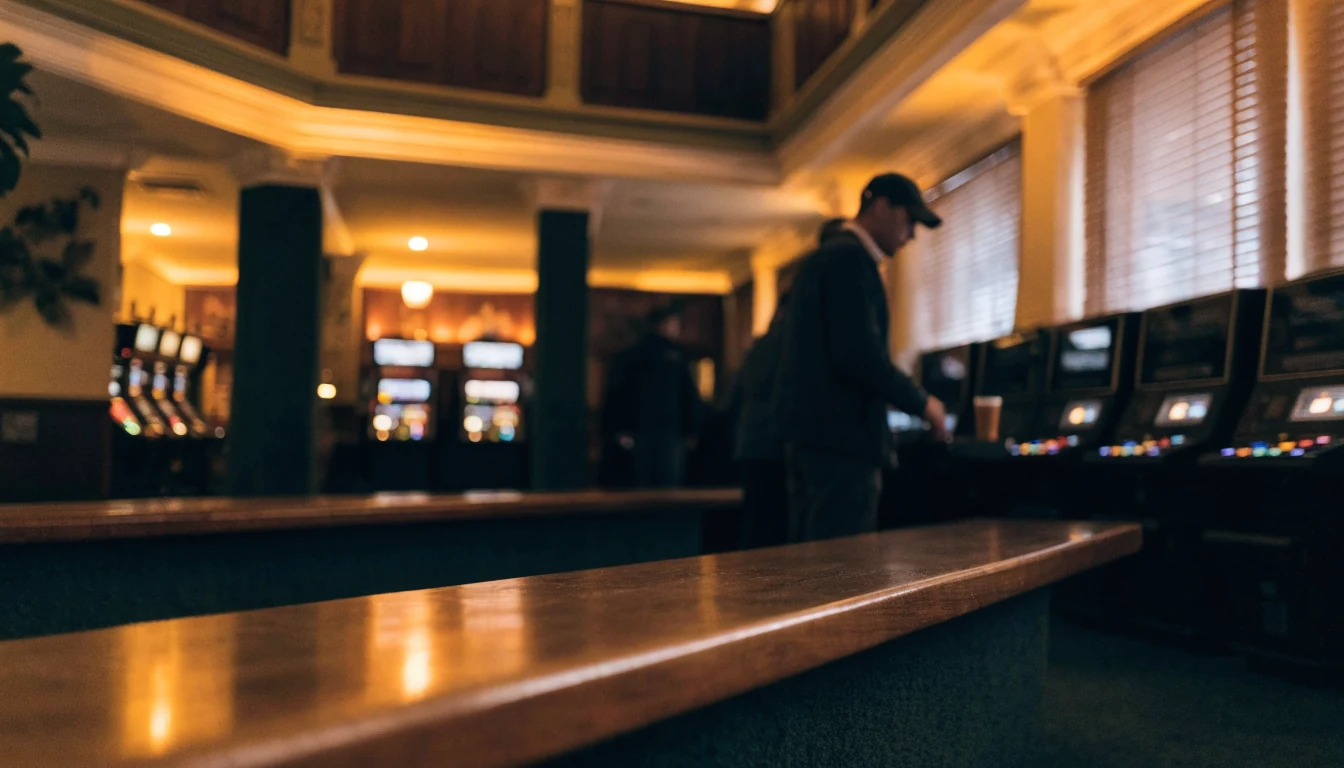
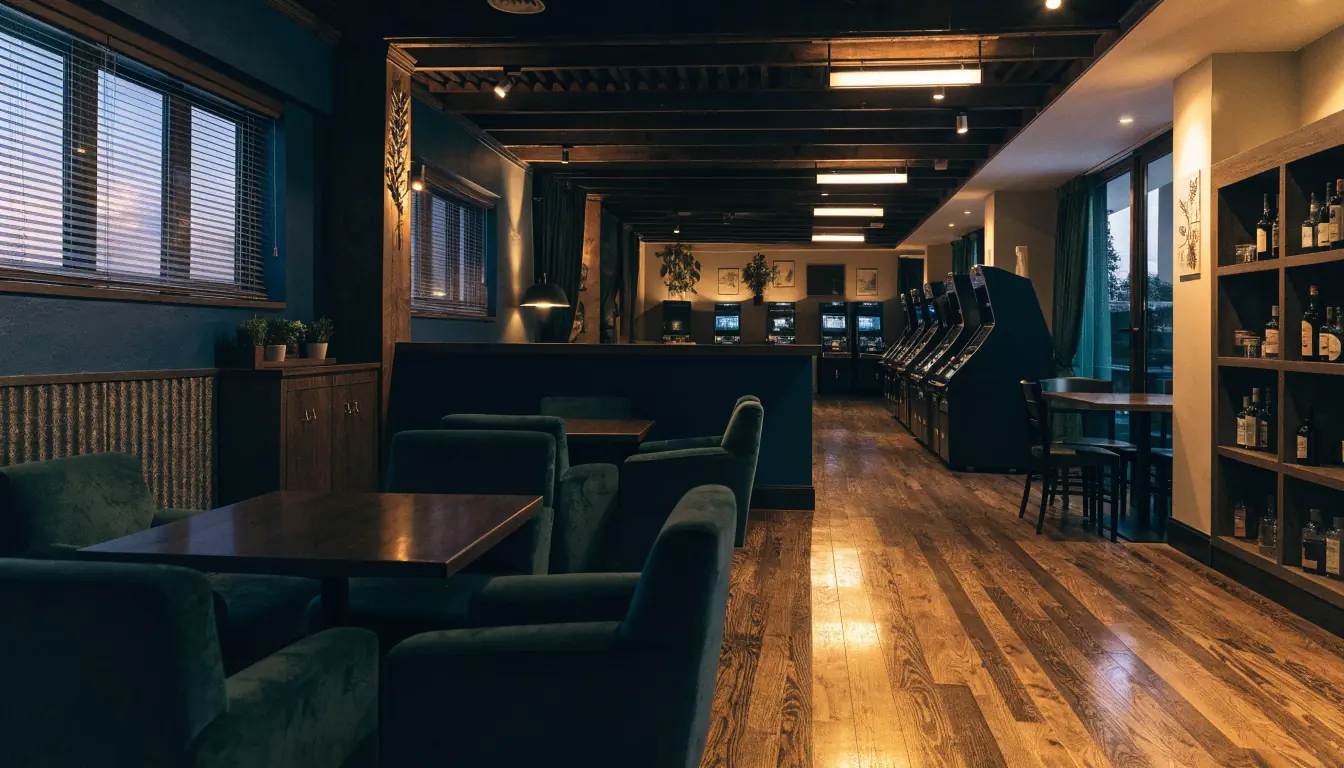
The phrase can describe gaming-machine spaces, but a licence from the relevant state or territory establishes a physical casino venue’s status.

In Australia, “pokies parlour” is best understood as a descriptive phrase, not as evidence of a particular legal status. It may suggest a place associated with poker machines, but the wording alone does not identify a licensed venue or establish that a business is a casino. The relevant distinction is between a physical casino operating under a local licence and an online service that uses similar language to describe itself.
Australia’s casino industry is regulated by states and territories. Each casino property operates under a licence issued by the jurisdiction where it is located. The licensing authority is therefore local rather than a single national casino regulator. A venue’s name or promotional description cannot replace that jurisdictional basis: the significant question is whether the physical property is licensed by the relevant state or territory.
“Pokies” is familiar Australian wording for gaming machines, while “parlour” can evoke a dedicated gaming space. Combined, the terms can sound like the name of a specific kind of venue. But they do not, by themselves, establish that the place is a casino, describe the terms of its licence, or show what it offers. The phrase may appear in descriptions of physical gaming venues as well as in the branding or presentation of online services. Those uses should not be treated as interchangeable.
For an Australia-focused search for online pokies, this list offers a quick reference to the stated licensing, deposit and payout details. Check the terms and local requirements before choosing a casino.
Kingmaker
Kingmaker lists crypto payouts at around 90 minutes and fiat payouts at 1–5 days. Its minimum deposit is A$30.
LevelUp Casino
LevelUp Casino lists a Curacao eGaming licence, OGL/2023/174/0082, held by Dama N.V. Its minimum deposit is A$15.
SkyCrown
SkyCrown lists a Tobique Gaming Commission licence and crypto payouts of around 10–15 minutes; fiat payouts are listed at 1–5 days. The minimum deposit is A$30.
Bizzo Casino
Bizzo Casino lists a Curacao Gaming Control Board licence, with TechSolutions Group N.V. named as the operator.
GoldenCrown
GoldenCrown lists Curacao Gaming Control Board licence OGL/2023/176/0095, held by Hollycorn N.V.
SpinsUp
SpinsUp lists Curacao Gaming Control Board licence OGL/2023/174/0082, held by Dama N.V.
Golden Pokies
Golden Pokies lists a Curacao licence.
Uptown Pokies
Uptown Pokies lists a Curacao licence and has been operating since 2017. Its minimum deposit is A$20.
Rollero Casino
Rollero Casino lists Curacao Gaming Control Board licence OGL/2023/176/0095, held by Hollycorn N.V.
MrPacho
MrPacho lists crypto payouts of 30–120 minutes and fiat payouts of 24–72 hours. Its minimum deposit is A$30.
This distinction matters because a land-based casino is a property operating within a state or territory licensing framework. An online service may use “parlour”, “casino” or “pokies” in its title without thereby becoming a locally licensed Australian casino. The Interactive Gambling Act 2001 prohibits operators from supplying online casino-style games to people located in Australia. Similar wording across a venue sign and a website does not make their regulatory positions equivalent.
The phrase “pokies parlour casino” can therefore refer, in ordinary language, to a casino associated with gaming machines, but it is not a reliable classification on its own. A casino’s status comes from its local licence, not from whether its name contains “parlour” or whether its description sounds familiar. Equally, the word “casino” on a website should not be read as proof that the service is an Australian land-based casino.
Physical entry has a clear nationwide age threshold: casino entry is restricted to people aged 18 or older. That common minimum does not mean every venue has identical operating conditions. Casino licensing sits with the relevant state or territory, so venue-specific details belong to the jurisdiction and property concerned. The age rule helps distinguish entry to a physical casino from a website’s description of its services; it does not validate an online service.
The scale of the land-based sector should also be described carefully. A specialist review reports more than 20 full-scale casinos across Australia’s eight states. That is a claim attributed to that kind of publication, rather than a settled, timeless count: the number and classification of properties can change. It should not be converted into a precise current inventory without a dated, authoritative basis. Nor should a count of casinos be confused with a count of every venue that has gaming machines. The label “parlour” does not resolve that difference.
In practical terms, the phrase can be read as a pointer to a subject, not as a credential. It may indicate that a description concerns pokies or a casino setting, but the licence and location determine whether a physical casino is part of Australia’s regulated land-based industry. If the phrase appears in connection with an online service, it describes the service’s own presentation; it does not alter the legal distinction between online casino-style games and licensed physical properties.
The expression is consequently ambiguous unless its context is specified. A reference to a local property concerns a venue whose operation falls under the licensing jurisdiction where it stands. A reference to a website concerns an online service, even if its wording imitates the language associated with land-based gaming. Keeping those meanings separate avoids treating a familiar phrase as proof of a licence, a venue type or an authorised online offering.
A sign-up bonus or a no-deposit bonus is a promotional claim, not evidence that an online casino is authorised to serve people in Australia. The wording may suggest that a new account receives a benefit without an initial payment, but it does not establish who operates the service, whether the offer is available, or whether the activity is lawful. In Australia, the central issue is not the label attached to a promotion: the Interactive Gambling Act 2001 prohibits operators from providing real-money online casino games to people physically in the country.
The Australian Communications and Media Authority (ACMA) is the federal regulator responsible for enforcing that Act and monitoring compliance with federal interactive gambling rules. Its role is relevant to bonus claims because an offer can be part of the advertising of a prohibited service. ACMA may ask Australian internet service providers to block websites that provide prohibited interactive gambling services or advertise them in Australia. The existence of a promotional page, account incentive or advertised benefit does not put the underlying service outside that framework.
This distinction matters for searches concerning a “pokies parlour” sign-up bonus or a casino no-deposit bonus. Such phrases describe what someone may be looking for, but they do not establish that an Australian casino offers an online promotion of that kind. Nor does the wording itself verify that a service is operated by a licensed land-based venue. A promotion cannot be treated as evidence of Australian approval simply because it uses familiar casino language or refers to Australian customers.
ACMA’s enforcement record provides context for how the federal rules are applied. Since enforcement actions began in November 2019, the regulator has blocked more than 1,455 websites associated with illegal gambling services and their affiliates. Blocking is an enforcement measure directed at access to services or advertising; it is not a certification process for promotions. A website’s appearance in promotional material therefore cannot, by itself, establish that its offer has been reviewed or authorised by ACMA.
There are also published figures on illegal services withdrawing from the Australian market after enforcement began in 2017, but those figures do not agree. One account puts the number above 210, while another reports more than 190. In either version, the measure concerns services that withdrew, not the number of bonus offers assessed, the value of promotions, or the status of any particular website.
The terms “no deposit” and “sign-up” describe promotional formats, not separate legal categories that make online casino games permissible. A claimed benefit does not change the prohibition on operators providing real-money casino-style games to customers in Australia. Likewise, an offer’s conditions or presentation do not demonstrate that the service complies with the Interactive Gambling Act. ACMA’s authority to enforce the law and seek website blocking applies to prohibited services and their advertising, rather than operating as a guarantee attached to an individual promotion.
A restrained reading of bonus claims therefore separates the promotional statement from verifiable regulatory facts. The statement may say that an incentive is available to new users or that no initial payment is needed; those assertions alone do not verify the offer or establish that it can lawfully be provided to people in Australia. The relevant established points are the federal prohibition, ACMA’s enforcement responsibility, its ability to request website blocking, and the enforcement figures with their documented disagreement. They do not substantiate a particular sign-up or no-deposit bonus.
Accordingly, searches for a pokies parlour no-deposit offer should not be read as proof that such a promotion is available from an Australian-authorised online casino. The same distinction applies when a claim is framed as a welcome benefit or presented alongside casino branding: promotional wording is not a regulatory finding. ACMA’s record concerns enforcement against prohibited services and advertising, and its figures should be understood within that scope rather than as confirmation of individual offers.
A website that opens from an Australian connection does not thereby become an Australian-licensed casino. The same is true if it accepts account traffic or appears at a different web address. These observations describe access, not the legal status of the service. A functioning page may show that a domain is reachable at a particular time; it cannot establish that the operator holds a licence issued by an Australian state or territory.
The distinction matters because the Interactive Gambling Act 2001 prohibits operators from providing real-money online casino games to people physically located in Australia. Casino-style services covered by the prohibition include online slots, poker and table games such as blackjack and roulette. A website’s design, account features or use of familiar casino language cannot override that legal framework. Nor does the appearance of a new address demonstrate that a service has obtained local authorisation.
The Australian Communications and Media Authority (ACMA) enforces the federal interactive gambling law and can ask internet service providers to block access to websites that provide prohibited services or advertise them in Australia. ACMA’s enforcement record reports that more than 1,455 illegal gambling and affiliate websites have been blocked since November 2019, following enforcement action. Blocking is an enforcement measure; it does not turn an accessible alternative address into evidence of lawful operation.
A specialist review has reported that ACMA action has included alternate domains associated with Fair Go. That report should be read narrowly: it indicates that domains linked to the service have been subject to blocking action, not that the service is licensed in Australia. It also does not establish that every address using a similar name is operated by the same entity.
A specialist review also describes how blocking can affect which domains resolve through Australian internet service providers, while alternate addresses may appear over time. This is a change in access conditions, not a change in licensing status. A domain that fails to load may be affected by blocking or other technical circumstances; a domain that does load is not thereby cleared by the regulator. Neither result, on its own, settles the legal status of an operator.
The ability to register, sign in or reach account pages is likewise not proof of Australian licensing. Those functions are controlled by the website, rather than being a public confirmation from an Australian regulator. An account interface can remain available even where the underlying service is prohibited from serving people in Australia. A change of domain may preserve access to that interface, but it does not alter the law governing the service.
This also limits what can be inferred from a site described as offering online casino play. The wording may refer to an offshore service or a web page designed for casino-style activity; neither description establishes that Australians may lawfully be offered the service. The relevant question is not whether the page works, but whether the activity is permitted under Australian law. For real-money online casino games offered to people in Australia, the federal prohibition applies.
ACMA can investigate and take enforcement action when operators provide or advertise prohibited online gambling services. Its blocking actions show that access restrictions form part of that response, while the appearance of an alternate domain does not negate the restriction or demonstrate approval. Accordingly, a working website, active account pathway or newly visible address should not be treated as evidence of Australian casino licensing.
Free chips and free spins describe different kinds of play, but neither phrase establishes that an Australian casino venue provides a particular offer. A chip may refer to a casino token or promotional credit; a free spin generally refers to a turn on a gaming machine without a separate charge for that turn. The wording alone says nothing about who provides the benefit, where it can be used, or whether it is available at all.
No particular free-chip or free-spin arrangement can be treated as an established feature of Australian casino venues. The distinction matters because promotional language can appear in material about online services as well as in descriptions of physical venues. Similar terminology does not make those settings equivalent, and a claim about one should not be transferred to the other without evidence tied to the specific venue and offer.
For a land-based venue, a claim about complimentary play would need to identify the venue and explain the relevant conditions. A general reference to “free” play does not show whether the benefit concerns a gaming machine, a table game, a promotional event, or something else. It also does not establish whether the benefit is currently available or who may access it. Without those particulars, the claim remains too vague to describe as a confirmed venue feature.
The phrase “free spins” is especially easy to mistake for a general casino benefit. It is commonly used to describe a feature of online slot promotions, but that usage does not confirm an offer at an Australian casino. Nor does an online promotion become a land-based venue offer merely because it uses familiar casino language. The same caution applies to free-chip claims: the phrase is not proof of a redeemable benefit at a physical property.
The regulatory distinction is relevant to interpreting such wording. Under the Interactive Gambling Act 2001, operators cannot provide real-money online casino games to people physically in Australia. Online slot games are included among the prohibited services. Consequently, promotional wording attached to an online casino-style service should not be read as evidence that the service is an Australian-licensed casino or that its offer is authorised for local customers. This does not establish that any particular online promotion exists.
A restrained description therefore separates the meaning of the terms from claims about availability. “Free chips” and “free spins” can indicate promotional play in some settings, but neither term verifies a benefit at a named Australian venue. Treating them as confirmed features without venue-specific substantiation would go beyond what the wording can support.
A review can combine claims that are checkable against public information with judgements that depend on the reviewer’s experience. Those categories should not be treated as equally established. A clear account identifies what its statements rest on; a confident tone alone does not show that a venue, service or assessment has been independently verified.
Some claims can be compared with documented features of Australia’s casino landscape. For example, the national total recorded for gaming machines installed in casinos and endorsed on venue licences is 3,308. This is a measure of the casino sector as a whole. It does not establish what is available at a particular venue, whether a reviewer visited it, or whether an online service performs as described. Aggregate figures provide context, not a substitute for evidence about an individual subject.
Other review statements are evaluations: that a service is reliable, that an experience was satisfactory, or that a particular feature works well. Such conclusions may reflect a genuine experience, but they are not confirmed merely by appearing in a review. Useful reporting distinguishes observation from inference and gives enough detail for the basis of an assessment to be understood. Where that basis is absent, the statement remains an unverified judgement.
The same distinction matters when a review discusses an online offering. A polished presentation, detailed descriptions or positive ratings do not, by themselves, establish the identity or quality of the service being assessed. Nor does a review’s use of the word “casino” settle what kind of operation it describes. The strength of a claim depends on the evidence attached to it, rather than on how specific or persuasive the wording sounds.
A practical way to assess a pokies parlour review is to separate its statements into three groups:
This separation also prevents an accurate statistic from lending unwarranted credibility to unrelated claims. A review may include a correct national figure and still provide no substantiation for its evaluation of a particular online service. Each claim needs to be assessed on its own terms.
For readers comparing pokies parlour reviews, the central issue is therefore not whether a review sounds comprehensive, but whether its evidence matches the claim. General sector information can describe the setting. It cannot verify an individual service’s quality, prove that a reviewer’s account is representative, or turn an unsupported assessment into a confirmed finding. Where a review does not make those boundaries clear, its conclusions should be read as claims rather than established facts.
Australia’s casino map is shaped by state and territory boundaries: each property operates under a licence issued by its local jurisdiction. National totals therefore combine locations governed by different authorities, rather than describing a single, centrally administered network. The geographic picture also depends on what a count includes. A casino count and a count of cities or gambling facilities are not interchangeable measures.
Identified as the country's largest gambling city with 11 gambling facilities.
Listed as the Northern Territory's leading city by casino count, with one casino.
A specialist review reports gambling activity across 147 Australian cities.
A specialist review reports gambling activity across 147 Australian cities. That figure is a snapshot attributed to the review, not a fixed national register: facilities can open, close or change classification, and the count may depend on the review’s method. It indicates a broad geographic spread, but does not establish that every city has a casino. Gambling facilities may include different types of venues, so a city-level total should not be read as a count of casino properties.
The same specialist review identifies Sydney, in New South Wales, as the country’s largest gambling city and assigns it 11 gambling facilities. This is a city-level facility count, not a statement that Sydney has 11 casinos. The distinction matters when comparing metropolitan areas: a tally of facilities can encompass venues beyond full-scale casinos, while a casino count refers to a narrower category. The review’s figure is best understood as a reported snapshot, rather than as a permanent ranking.
The Northern Territory offers a smaller-scale regional example. According to that specialist review, its three casinos are distributed across three cities. Alice Springs is listed as the territory’s leading city by casino count, with one casino. These statements describe a pattern across the territory, but the available figures do not identify all three cities or establish how many other types of gambling facility are present in each. They therefore support a limited geographic comparison, not a complete inventory of the territory’s gaming venues.
A specific location can be stated more precisely where an address is available: Lasseters Casino is at 93 Barrett Drive in Alice Springs, Northern Territory. That address gives a concrete point on the map, but it does not by itself verify the broader city or territory totals reported in the specialist review. Counts and addresses answer different questions: an address locates a property, whereas a regional count depends on scope, classification and the date of compilation.
For geographic comparisons, the most useful distinction is between a named property, a city’s reported facilities and a jurisdiction’s casino count. Those measures should not be combined as though they represented the same unit. The reported national city figure and Sydney total offer a broad urban perspective; the Northern Territory figures illustrate distribution across a smaller jurisdiction. Because the totals come from a specialist review and may change, they are appropriately treated as attributed observations rather than definitive, enduring market statistics.
Bonus language attached to a pokies parlour can refer to several different things: a promotion at a physical casino, an online offer, or wording copied from a third-party page. These are not interchangeable. A claim about a venue does not, by itself, establish that an online service is authorised to provide casino gambling in Australia.
The legal distinction is material. Under the Interactive Gambling Act 2001, operators must not provide real-money online casino games to people physically located in Australia. Casino-style games, including slots, poker and table games, fall within the prohibited interactive gambling services described by the law. A bonus advertised in connection with such a service does not change that status.
A general bonus label also does not establish what an offer involves. It cannot show whether the wording concerns a venue or an online service, who may qualify, or whether the promotion is current. Those details require direct, reliable information about the specific claim. Repeating promotional language without that context risks presenting an unverified statement as an established offer.
The Australian Communications and Media Authority (ACMA) enforces federal interactive gambling laws and can investigate operators that provide or advertise prohibited services. It may ask Australian internet service providers to block access to websites offering prohibited gambling services or advertising them. ACMA reports more than 1,455 illegal gambling and affiliate websites blocked since November 2019 following enforcement action.
Published totals for services withdrawing from the Australian market are not consistent: one account reports more than 210 since enforcement began in 2017, while another reports more than 190. The discrepancy means neither figure should be treated as an uncontested count. It does not alter the legal distinction between a venue-based promotion and an online casino offer.
Accordingly, bonus wording should be read as a claim, not as evidence of Australian online authorisation or of a promotion’s terms. The presence of a promotion on a page, or its association with a parlour name, cannot establish that a real-money online casino service may lawfully be offered in Australia.
“VIP” can describe a range of arrangements, from restricted entry to membership-based access, but the term alone does not identify which arrangement applies to a particular Australian casino. Nor does it establish that a venue operates a programme under that name. Claims about eligibility, member benefits or access conditions require details tied to the venue concerned.
Australian casinos operate under licences issued by their state or territory. That licensing structure identifies the jurisdiction responsible for a property; it does not, by itself, confirm the existence or terms of a VIP programme. A reference to a “VIP parlour” should therefore not be treated as proof of a specific room, membership tier or invitation process.
The distinction matters because venue access and programme access are separate questions. A casino may have its own entry conditions, while any additional membership arrangement would require separate, venue-specific confirmation. No general rule about VIP entry or membership can be inferred across Australian casinos from the term alone.
The broader market has a nationwide minimum casino-entry age of 18, and major casinos operate around the clock. These general conditions do not establish whether a particular VIP area exists, who may enter it, or whether membership is available. Such conclusions depend on information about the individual property and its current arrangements.
Major Australian casinos typically operate around the clock and maintain a nationwide minimum entry age of 18. However, these general rules do not confirm the existence or terms of specific VIP programmes.
Accordingly, the phrase “VIP parlour casino” is not enough to verify a venue or a benefit. A reliable description would need to identify the property and distinguish its ordinary entry requirements from any separately stated membership conditions. Without that distinction, promotional wording can suggest a level of access that has not been established.
The phrase “parlour pokies” can suggest a distinct type of gaming venue or a particular group of machines. In the Australian casino context, however, the available national figure concerns gaming machines installed in casinos; it does not establish a separate category called a parlour or identify where machines are situated within a property.
The recorded total is 3,308 gaming machines endorsed on venue licences and installed in Australian casinos. This is a combined count across the country. It provides a measure of the casino gaming-machine estate, but it does not describe the distribution of machines among states, venues, floors or rooms. Nor does the figure establish that a particular casino has a designated parlour.
The licence wording and the installation count also describe related but distinct details: machines are counted as installed, while endorsement appears on venue licences. The national total should therefore be read as a broad measure, not as a venue-by-venue inventory or a claim about the arrangement of facilities.
“Pokies” is a familiar Australian term for gaming machines, but using it alongside “parlour” does not, by itself, verify a separate venue type or a specific set of machines. The count does not name individual games, describe their features, or indicate which machines can be found at a particular property. It also cannot show whether a venue has changed its machine inventory since the figure was compiled.
Accordingly, the national count supports a limited conclusion: casinos in Australia have 3,308 licensed and installed gaming machines in aggregate. Any more specific claim about a parlour, a venue’s layout or machine availability would require evidence about that individual property. The national figure alone cannot supply those details.
“Real money” describes how an online service proposes to handle play; it does not establish that the service may lawfully offer casino games in Australia. Under the *Interactive Gambling Act 2001*, operators must not provide real-money online casino games to people physically located in Australia. Casino-style games fall within the prohibited interactive gambling services covered by the law.
This distinction matters because a site’s wording, account functions or apparent ability to accept deposits cannot create an Australian online casino licence. Australia regulates land-based casinos through state and territory licensing, but that system does not authorise online casino services for people in the country. Nor does an overseas licence change the Australian restriction on an operator providing such services locally.
The legal prohibition is directed at service providers, not at players: the framework does not impose a fine or criminal prosecution on an individual merely for playing at an offshore casino. That distinction should not be confused with an endorsement of a service or a finding that it is lawful for an operator to serve Australian customers.
The Australian Communications and Media Authority (ACMA) enforces the federal interactive gambling law. It can investigate prohibited services and take enforcement action, including requesting that internet service providers block access to websites. A domain that remains reachable, or a replacement address that appears after a block, is not evidence of Australian authorisation.
Accordingly, a real-money claim should be read as a description of the service’s proposed play model, not as proof of its regulatory standing in Australia. The relevant legal question is whether an operator is providing prohibited interactive gambling to people in the country; site access and payment functionality do not answer that question.
Prepared by the Rollxo Casino editorial staff.